Your backtest is not your track record
Backtests are optimistic by construction. Forward journaling is the only record that includes the part of the system that hesitates, panics and clicks early — you.
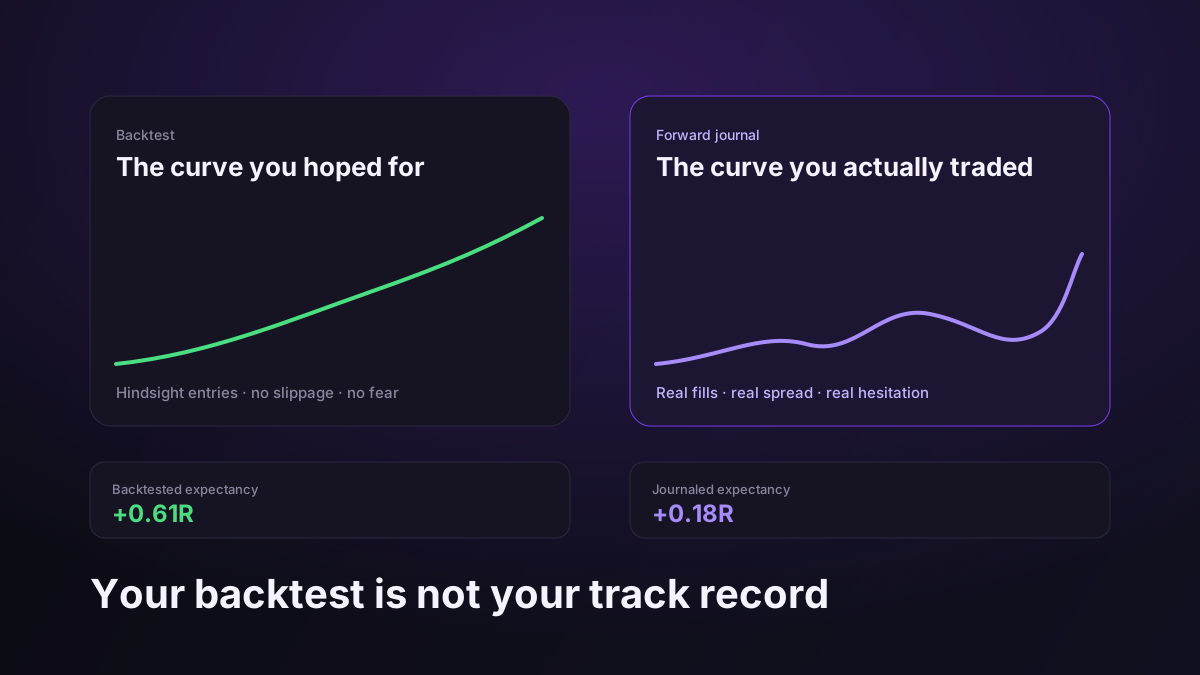
A backtest is a useful thing. It tells you whether an idea has any statistical basis at all before you spend real money finding out. But traders routinely mistake it for evidence of what they will earn, and the gap between the two is where most of the disappointment in this business lives.
The reason is simple. A backtest measures a strategy. Your account measures a strategy plus a human operating it under uncertainty. Those are different systems, and the second one is always worse.
Everything a backtest quietly leaves out
Hindsight in the entry. When you scroll a chart looking for your setup, you can see what happened next in your peripheral vision. It is nearly impossible to unsee. The candles that would have made you hesitate live in the same screen as the outcome, and the entries you mark are systematically better than the ones you would have taken live.
Costs. Spread, commission and slippage sound like rounding errors until you compute them per trade. On a scalping system averaging 0.3R per trade, a cost of 0.05R per trade is 17% of your entire edge. Backtests with idealised fills routinely omit it.
Skipped trades. In a backtest, every valid signal is taken. Live, you miss some because you were away, some because the last two lost and you wanted confirmation, and some because the setup appeared during news. The set of trades you actually take is not a random sample of the signals — it is a sample biased by your own state.
The exit. This is the big one. Backtests exit at rules. Humans exit at feelings — cutting winners early to bank a green day, moving a stop to break-even out of anxiety, or holding past the invalidation because it will surely come back. Exit behaviour is where the average win shrinks and the average loss grows, and it is invisible in a backtest.
What forward journaling actually measures
A forward journal captures the whole system, you included. Real fills at real spread. The trades you skipped, ideally logged as skips so you can see the pattern. The exit you actually took next to the exit the plan specified. The emotional state at entry.
That record produces an expectancy number you can trust, because it is the number your account will experience. It is almost always lower than the backtest — a strategy that tested at +0.6R commonly journals at +0.2R — and that is not a failure. It is the first honest measurement you have had.
Use both, for different jobs
The workflow that works is unglamorous:
- Backtest to reject. Its best use is filtering out ideas with no edge at all, cheaply. Treat a good result as permission to continue, not as a forecast.
- Forward journal a fixed sample at small size. Fifty to a hundred trades at minimum size, every one logged in R, every deviation from plan noted.
- Compare the two. The gap is your execution cost, and it is the most actionable number in your journal. If backtest says +0.6R and live says +0.2R, the missing 0.4R is not the market — it is behaviour, and behaviour is fixable.
- Scale only what the forward record supports. Size up on the journaled expectancy, never the backtested one.
The uncomfortable version
If your live results are far below your backtest, the strategy is usually not the problem. You are. That sounds harsh, but it is the good news — a strategy flaw needs new research, while an execution gap needs a checklist and a few weeks of honest logging. You can only fix it once you have both numbers side by side, which is exactly what a journal that fills itself is for.