What to actually log in a trading journal (and what to skip)
Elaborate journals get abandoned in three weeks. Six fields you will maintain forever beat thirty you will not — here is the shortlist and the reasoning behind each.
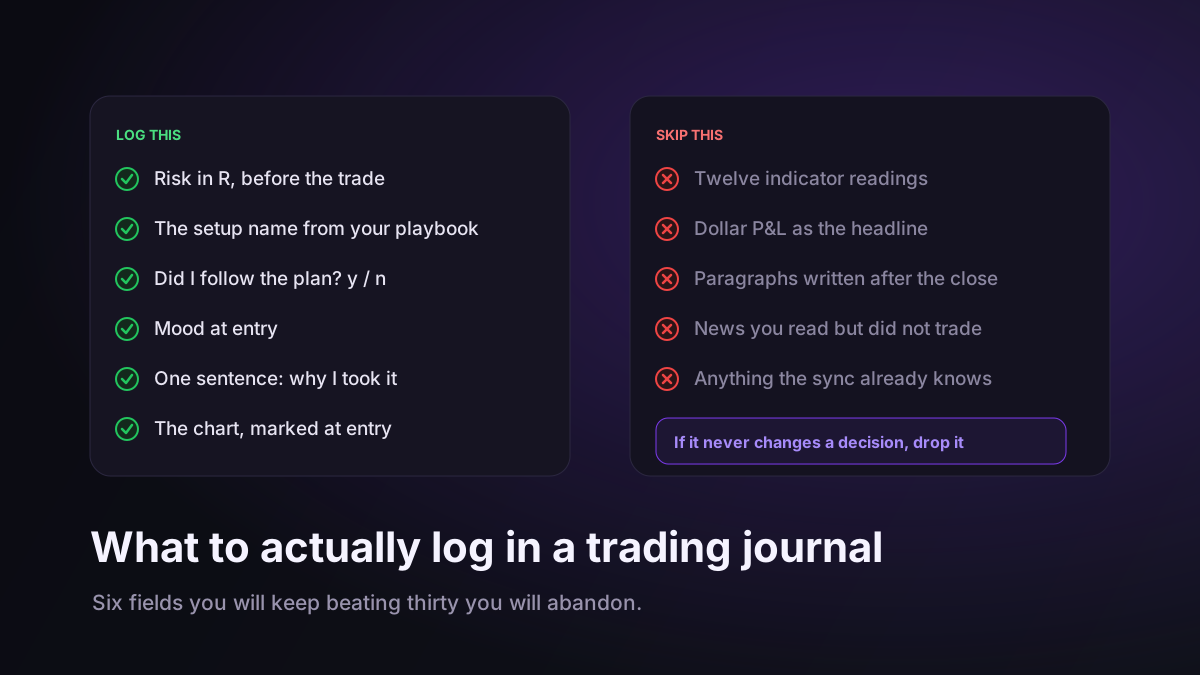
The most common journaling mistake is not logging too little. It is building something so thorough that maintaining it becomes a second job, then quietly abandoning it by week three. A journal you keep for a year at moderate detail is worth more than a perfect one you keep for a month.
So the question is not "what could I log?" but "what is the shortest list that still changes decisions?" Here it is.
Log these six
1. Risk in R, recorded before entry. Not after. Writing the intended risk before you click makes size drift visible — the day you quietly risked 2.5R because you were sure shows up as a number rather than a vague memory. It is also what makes every other statistic comparable across time and account size.
2. The setup name from your playbook. One word or a short tag. Without it you can compute your overall expectancy but never the far more useful per-setup expectancy — and almost every trader discovers that one setup carries the account while another quietly bleeds it. You cannot cut what you cannot see.
3. Did I follow the plan? Yes or no. A single binary field, and possibly the highest-value one in the whole journal. It separates outcome from process. A losing trade that followed the plan is a cost of business. A winning trade that broke it is a warning. Track the percentage of trades where this is yes; that number is your actual discipline, and it moves before your P&L does.
4. Mood at entry. Calm, rushed, frustrated, euphoric — a tag, not an essay. Aggregate a few weeks of it and your tilt triggers stop being a feeling and start being a filter you can query. The pattern is usually blunt: rule breaks cluster after losses.
5. One sentence on why you took it. Written before or immediately at entry, while the reasoning is still real. Post-hoc explanations are reconstructions, and reconstructions are flattering. This sentence is what you read in review to see whether the reason was in your plan or invented on the spot.
6. The chart, marked at entry. A picture with your entry, stop and targets on it. Reading twenty of these side by side reveals things no table will — that you consistently enter mid-range, or take the third push of a move, or set stops just inside an obvious level.
Skip these
Indicator readings. Twelve values captured per trade feels rigorous and almost never changes a decision. If a reading is genuinely part of your entry criteria it belongs in the setup definition, not in a per-trade spreadsheet column.
Dollar P&L as the headline. Dollars fluctuate with account size and position size, so they make trades incomparable. Keep them, but read R.
Long post-session essays. They feel productive and are rarely reread. Three bullets you will actually revisit beat four paragraphs you will not.
News you read but did not act on. Interesting, not actionable, and it inflates the cost of every entry.
Anything your platform or sync already knows. Entry price, exit price, timestamps, duration, symbol, direction, partial fills — all of it can be captured automatically. Re-typing it by hand is the single biggest reason journals get abandoned, and it adds nothing a database cannot supply.
The test
Before adding a field, ask: in the last three months, would this have changed a decision I made? If the answer is no, it is not data. It is homework. The journal that compounds is the one narrow enough that you still fill it in on the day you lost — because those are precisely the entries you will most want to read a year from now.