Trailing drawdown, explained with actual numbers
Static, intraday trailing, end-of-day trailing: three rules that sound alike and behave very differently. Worked examples, the one number to watch before every session, and how to size from it.
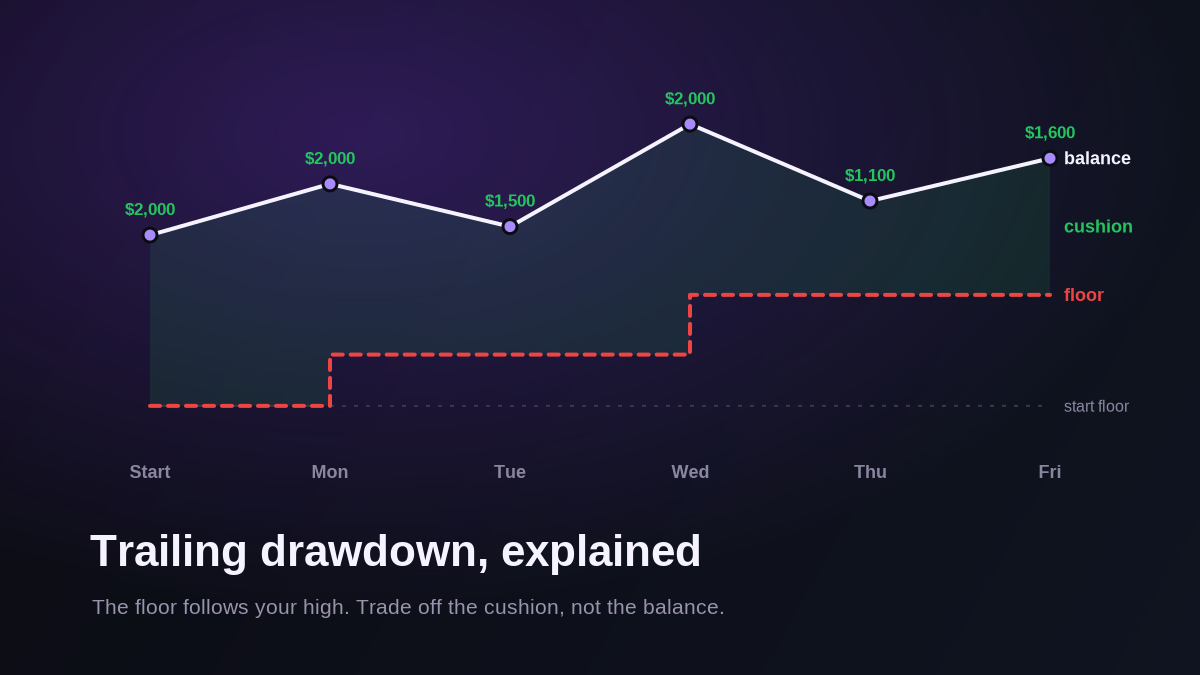
Most prop firm evaluations come with a maximum loss limit, and most traders read it as a fixed line: "I can lose $2,000 before I'm out." On a lot of accounts — especially futures evaluations — that is not how it works. The line moves. It follows your best balance upwards and never comes back down, and if you do not understand exactly how it moves, it will end an account that was, by every other measure, profitable.
This post walks through the three common versions of the rule with real arithmetic, then turns it into something you can actually use: one number to check before every session, and a way to size trades from it.
The exact rules differ between firms and between account types at the same firm, so treat the figures below as a worked illustration and read your own firm's rulebook for the specifics.
The three kinds of maximum loss
Static drawdown. The floor is set once, at the start, and never moves. A $50,000 account with a $2,000 limit has a floor of $48,000 forever. Simple, forgiving, and increasingly rare.
End-of-day (EOD) trailing drawdown. The floor follows your highest closing balance. At the end of each day, if your balance is a new high, the floor moves up so that it sits $2,000 below it. What happens during the day does not move the floor — only where you finish.
Intraday trailing drawdown. The floor follows your highest equity, including open profit, in real time. If a trade is up $1,200 at any moment, the floor moves up by $1,200 at that moment — even if you never bank a cent of it.
The same trade under all three rules
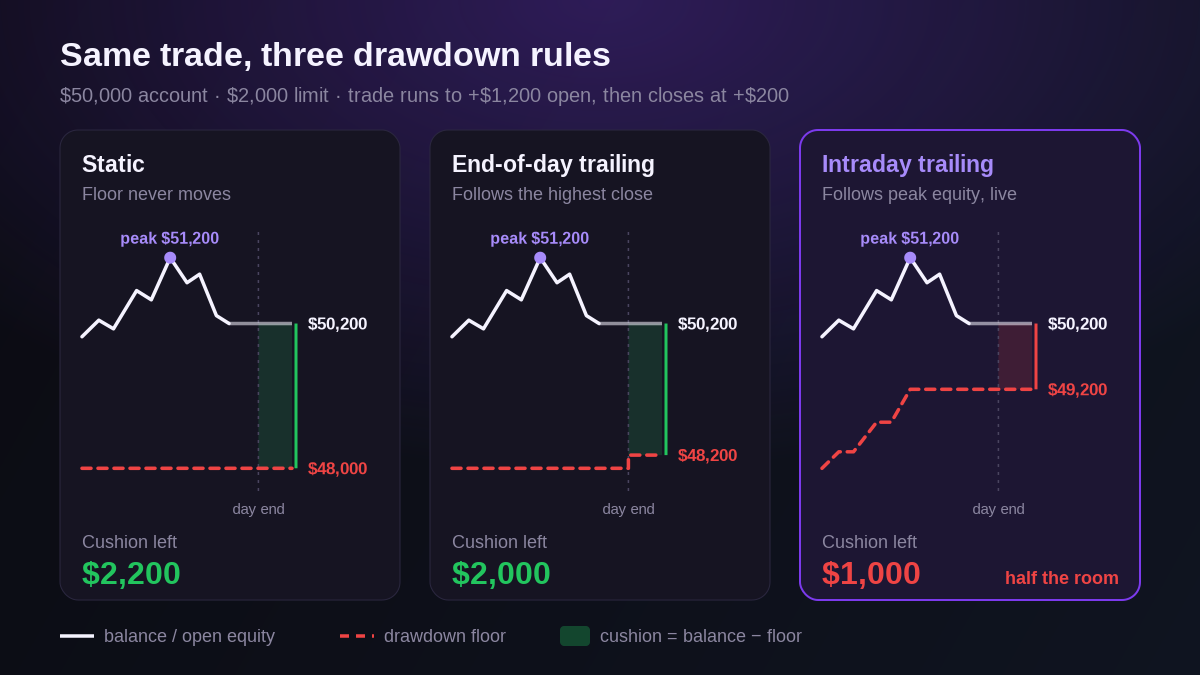
Take one $50,000 account with a $2,000 limit. On day one you take a single trade. It runs to $1,200 in open profit, then reverses, and you close it for +$200.
| Rule | Peak used for the floor | Floor after the trade | Balance | Cushion left |
|---|---|---|---|---|
| Static | — | $48,000 | $50,200 | $2,200 |
| EOD trailing | $50,200 (closing balance) | $48,200 | $50,200 | $2,000 |
| Intraday trailing | $51,200 (peak equity) | $49,200 | $50,200 | $1,000 |
Same trade, same result, same day — and under intraday trailing you have half the room you had that morning. You made $200 and lost $1,000 of cushion. That is the part people miss: under an intraday rule, open profit you give back is a real cost, even when the trade closes green.
The one number that matters: cushion
Forget the balance. The number that decides whether you survive is the distance between your balance and the floor:
cushion = balance − floor
On a trailing account the cushion can only be as large as the limit itself, and every pullback from a high eats into it. Here is a week on an EOD trailing account:
| Day | Closing balance | Highest close | Floor | Cushion |
|---|---|---|---|---|
| Start | $50,000 | $50,000 | $48,000 | $2,000 |
| Mon | $50,600 | $50,600 | $48,600 | $2,000 |
| Tue | $50,100 | $50,600 | $48,600 | $1,500 |
| Wed | $51,300 | $51,300 | $49,300 | $2,000 |
| Thu | $50,400 | $51,300 | $49,300 | $1,100 |
| Fri | $50,900 | $51,300 | $49,300 | $1,600 |
The account is up $900 on the week. It has also been within $1,100 of failing. Check the cushion — not the P&L — before every session.
When the trailing stops
On many trailing accounts the floor stops moving once it reaches a set level, often the starting balance. In the example, once your highest close reaches $52,000, the floor reaches $50,000 and locks there. From then on the account behaves like a static one: your floor is your starting balance, and every dollar above it is genuine cushion.
That changes how you should think about the early phase. Until the floor locks, you are never more than one limit away from failing, however well you have done. The first job on a trailing account is not "hit the target" — it is "get the floor locked", and the way to do that is the same as everything else here: small, consistent, boring.
Size from the cushion, not the balance
Since the cushion is what you can actually lose, size from it. Decide how many consecutive losers you want to be able to survive — say eight — and divide:
risk per trade = cushion ÷ 8
- Cushion $2,000 → $250 per trade.
- Cushion $1,100 (Thursday above) → about $137 per trade.
- Cushion $1,600 → $200 per trade.
This does two useful things automatically. When you are near your high, you trade normal size. When you are in a drawdown and close to the line, your size shrinks before you have to decide to shrink it — exactly when your judgement is least reliable.
The daily loss limit is a second, separate line
Many accounts also carry a daily loss limit — say $1,000. It does not replace the trailing floor; it sits alongside it. Whichever line is closer is the one that binds today. On Thursday above, the cushion was $1,100 and the daily limit $1,000, so they were practically the same line. On Monday morning the cushion was $2,000, but you still could not lose more than $1,000 in a day.
Write both numbers down before the open and trade off the smaller one.
Intraday trailing changes trade management
If your account trails intraday, a few habits matter more than usual:
- Big open profit is a liability until it is banked. A trade that runs to +2R and comes back to breakeven has cost you 2R of cushion. Decide in advance how you will handle that — partial profits, a trailing stop, or simply accepting it — rather than discovering it live.
- Holding winners longer has a hidden cost. Strategies that rely on riding a trend through deep pullbacks are harder under intraday trailing than the same strategy on a static account.
- News spikes count. A spike in your favour that instantly reverses still moves the floor.
Journaling it
Put three numbers at the top of each day's entry in your journal: balance, floor and cushion. It takes ten seconds and it keeps the real constraint in front of you.
Then review the trades that hurt the cushion most. In Retrace, every charted trade shows its MAE and MFE — how far price went against you and in your favour while you were in it. On an intraday trailing account, MFE is literally how far that trade moved your floor. Sort for trades with a large MFE and a small (or negative) result, and you have a list of exactly where your cushion went.
A trailing drawdown is not unfair, and it is not a trick. It is a rule that rewards consistency and punishes round-trips. Once you trade off the cushion instead of the balance, it stops being a surprise.