Trading affirmations that actually change how you trade
Most trading affirmations are about money, and money is the one thing you can't do on the next trade. How to write affirmations about the behaviour that produces the money, why they have to be believable, and how to check them against your own journal every week.
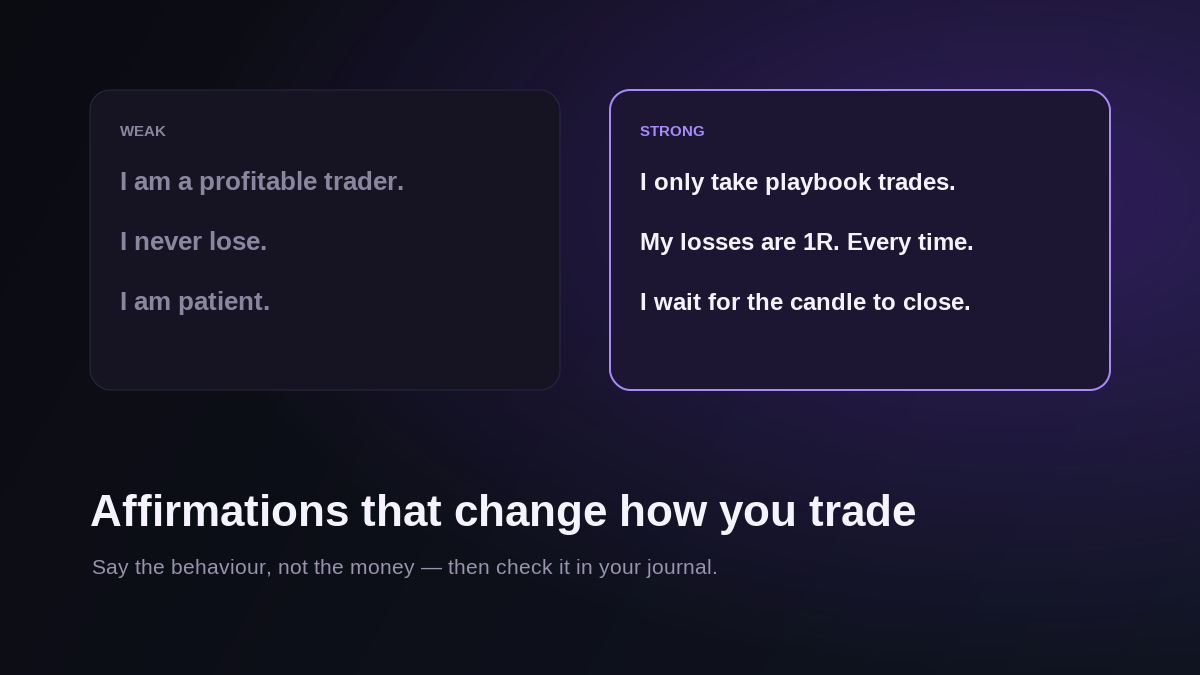
"I am a millionaire trader." Plenty of traders have said it every morning and then revenge-traded by lunch. The words weren't the problem. The problem is that the affirmation pointed at something they couldn't do on the next trade.
An affirmation works when it changes what you do in the moment that matters — the second before you click buy, the minute after a loss, the hour you've already hit your target. This post is about writing affirmations that reach those moments, and checking that they did.
Why most affirmations do nothing
Three patterns show up again and again:
- They are only about the outcome. "I make $10,000 a month" describes the destination. It says nothing about what to do when the trade you're in goes −0.8R.
- They aren't believable. If part of you knows the number doesn't add up, saying it louder doesn't help. It trains you to ignore your own voice.
- They have no trigger. An affirmation you say once at 07:00 is gone by the open. The ones that work are tied to a moment you will definitely meet.
Four rules for affirmations that stick
1. Present tense, first person, about behaviour. "I risk the same amount on every trade." Not "I will try to", not "traders should". You are describing who you already are.
2. One affirmation per leak. Look at your last fifty trades and find what actually cost you money. Write the affirmation that is the exact opposite of it.
3. Tie it to a trigger. "When I take a loss, I stand up before I look at another chart." The trigger — the loss — reminds you of the words at the moment you need them.
4. Keep the outcome, but make it add up. It's fine to say "2027 is my $48,000 year" as long as the win rate, RR and number of trades behind it can produce $48,000. Belief comes easily when the arithmetic is on your side.
Weak vs strong
| Weak | Strong |
|---|---|
| I am a profitable trader. | I only take trades that are in my playbook. |
| I never lose. | My losses are 1R, every time. My stop doesn't move. |
| I am patient. | I wait for the close of the candle before I enter. |
| I make money every day. | When I hit my daily loss limit, I am done for the day. |
| I am rich. | I risk 0.5% per trade, and I let the year compound. |
The strong column is less exciting to read, and that's the point. Every line on the right is something you can do — or fail to do — on the next trade, so you'll know by tonight whether it was true.
Say them where you'll trade
Read your affirmations in the place where the trading happens, right before you start. In Retrace's Manifest, your affirmations sit in the guide, next to the vision of the year you're calling in — the full dashboard of that year, built from your own goals:
Look at the finished year, read the lines out loud, then trade one trade as the person on that dashboard would.
Check them against your journal
An affirmation is a claim about your behaviour, and your journal can check claims. Once a week, put each line next to the numbers:
- "My losses are 1R." What is your average loss in R? If it's −1.3R, the affirmation isn't true yet — your stops are moving.
- "I only take playbook trades." What share of last week's trades had a strategy assigned? Look at the ones that didn't.
- "When I hit my limit, I'm done." Open the calendar. Were there any days where you lost past your limit?
- "I risk the same on every trade." Sort your trades by size. Are the biggest ones clustered after losses?
When a line passes for four weeks in a row, it's no longer an affirmation — it's a fact about you. Replace it with the next leak.
Affirmations change behaviour, not markets. Trading carries risk — the process is what you control.