The 20-minute replay routine that builds pattern recognition
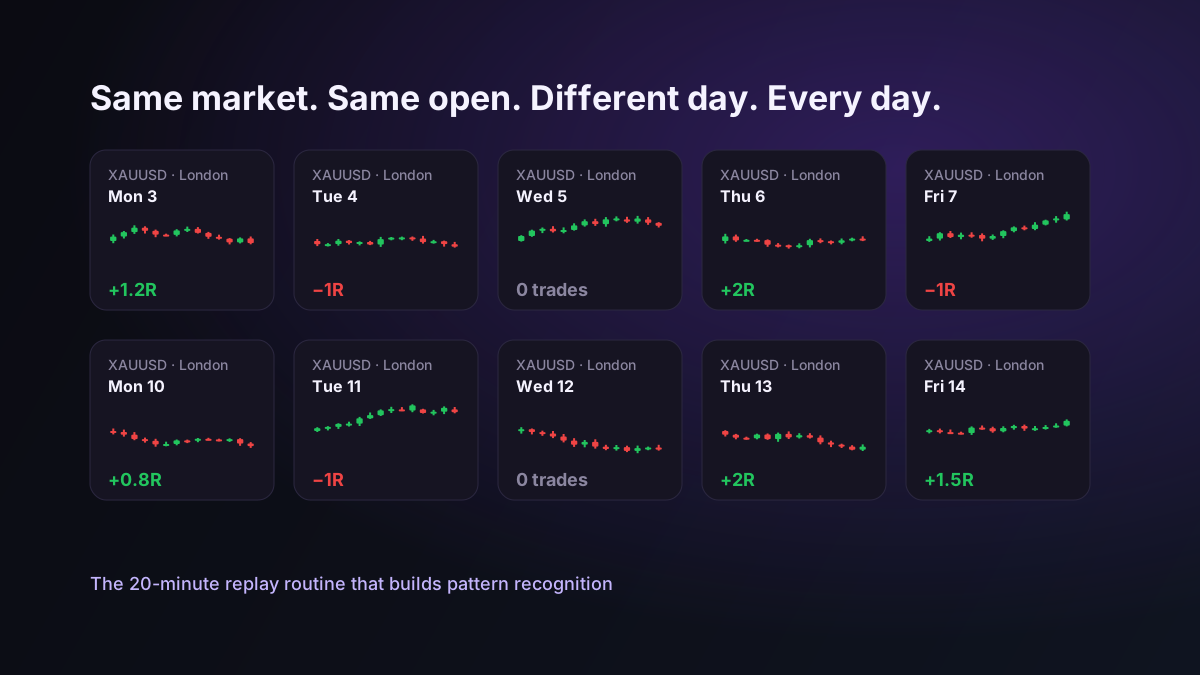
Pattern recognition is a sample size, not a rule. Same market, same session open, a different day every day, one sentence written down — a routine for anyone with twenty minutes.
Every experienced trader has had this conversation with a beginner:
"How do you know that's a good setup?" "I've just… seen it a lot."
That is a real answer, even if it's an unsatisfying one. Pattern recognition isn't a rule you learn; it's a sample size you accumulate. The problem is that accumulating it live is slow (one London open per day), expensive (you pay for every wrong guess), and emotionally noisy (you remember the trades that hurt, not the ones that taught).
Replay fixes all three at once. Here's a routine to get the most out of it — built for someone with twenty minutes a day, not a full-time desk.
The routine in one line
Same market. Same session. Different day. Every day. Write down one thing.
That's it. Everything below is detail.
Why the same market and session
Because you're building a library, and a library needs a shelf. If Monday you replay gold at the London open, Tuesday Bitcoin at the New York open, and Wednesday EURUSD in Asia, you've had three interesting sessions and learned almost nothing transferable. Each market has its own rhythm; each session has its own personality.
Pick one pair. Pick one open. Live there for two or three weeks. When the London open on gold starts to feel familiar — when you catch yourself expecting the first fake-out — you've built something. Then, and only then, add a second shelf.

The 20-minute session
Minutes 0–2 — set up. Open Replay, choose your market, choose a day you haven't seen (use Surprise me if you don't trust yourself not to cheat), jump to your session open, M5 timeframe.
Minutes 2–7 — watch, don't trade. Play at 1× or 2×. Narrate. "Pushing into yesterday's high. If it breaks and comes back under, I'd want to be short." You're training the part of you that predicts. Being wrong here costs nothing, so be wrong loudly.
Minutes 7–17 — trade your rules. Not "trade". Trade your rules. If your rule is "wait for a break and retest", then you wait for a break and retest, even if it means you take zero trades. Zero trades taken correctly beats three trades taken because you were bored. Use a fixed stop and a fixed reward-to-risk (the ticket shows you the R before you click) so the numbers stay comparable day to day.
Minutes 17–20 — end and log. Hit End session, look at the review, and write one sentence somewhere you'll see again. Not the P&L. Something you noticed:
- "The first move after the open reversed within 15 minutes — third day in a row."
- "I bought a breakout that had no pullback. Rule says wait. I didn't."
- "Took no trades. Right call; it went sideways all morning."
That sentence is the actual product of the session. The P&L is a by-product.
Speed is a tool, not a cheat
Beginners either play at 1× the whole time (and get bored, and force trades) or at 20× (and never actually see a candle form). Use both deliberately:
- 20× to skip. Nothing happening? Fast-forward. Real traders don't stare at a flat market for an hour either.
- 1× or 0.5× to feel. Price approaching your level? Slow down. Watch the candle form — the wick, the hesitation, the close. That's the part live traders see and screenshots don't show.
- Next candle to think. Pause and step one candle at a time when you're deciding. There's no clock in replay. Use that.
Change the timeframe mid-replay
Switching between M5, M15 and H1 while playing is instant, and it teaches something no single-timeframe chart can: the M5 candle that looks like a reversal is often just the middle of an H1 candle that's still going. Get in the habit of zooming out before you click Buy or Sell. In replay it costs a second. Live it costs a stop-out.
After ten sessions
Go back through your ten sentences. Patterns will be there — not on the chart, in you. Maybe you're always early. Maybe you never take the second setup after a loss. Maybe your best sessions were the ones where you took one trade or none.
That's pattern recognition too. It's the kind that actually changes results.
A note on the free plan
Free accounts get three replay sessions a day — enough to run this routine daily, compare two markets, or replay a day you got wrong. When three stops being enough, Pro is unlimited. Either way, do the writing part. The chart doesn't remember; you have to.