Scaling out: what partial profits really cost
Taking half off at 1R feels safe and makes more trades end green. Whether it makes more money depends entirely on how your trades move. A worked comparison of three exit rules on the same 100 trades, and how to test it on yours.
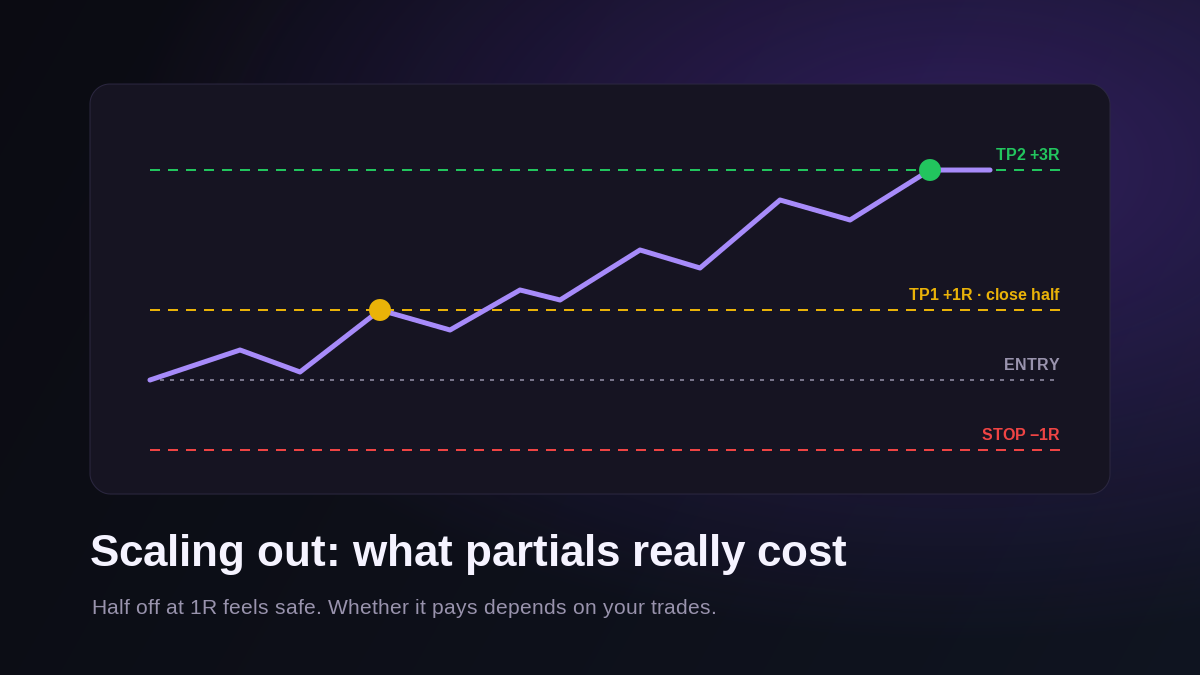
Taking partial profits is one of the most popular trade-management habits there is. Price reaches +1R, you close half, and the rest of the trade is "free". It feels responsible. It makes far more of your trades end in profit.
What it does to your total is another matter, and it depends entirely on how your trades tend to move. This post works through the arithmetic.
Three exit rules, same trades
Take 100 trades with a 1R stop and sort them by how far each one ran in your favour before either stopping out or hitting the furthest target:
- 40 never reach +1R, then stop out.
- 20 reach +1R but not +2R, then stop out.
- 15 reach +2R but not +3R, then stop out.
- 25 reach +3R.
Now run three exit rules over the same 100 trades. The stop stays at −1R throughout, so the only thing that changes is the exit.
All out at 2R. The 40 and the 20 lose 1R each: −60R. The 15 and the 25 all reach +2R and bank it: +80R. Total: +20R.
Half at 1R, rest at 3R. The 40 lose 1R: −40R. The 20 and the 15 each bank +0.5R on the first half, then lose 0.5R on the second: 0R. The 25 bank +0.5R and then +1.5R: +50R. Total: +10R.
All out at 3R. The 40, 20 and 15 all lose 1R: −75R. The 25 bank +3R: +75R. Total: 0R.
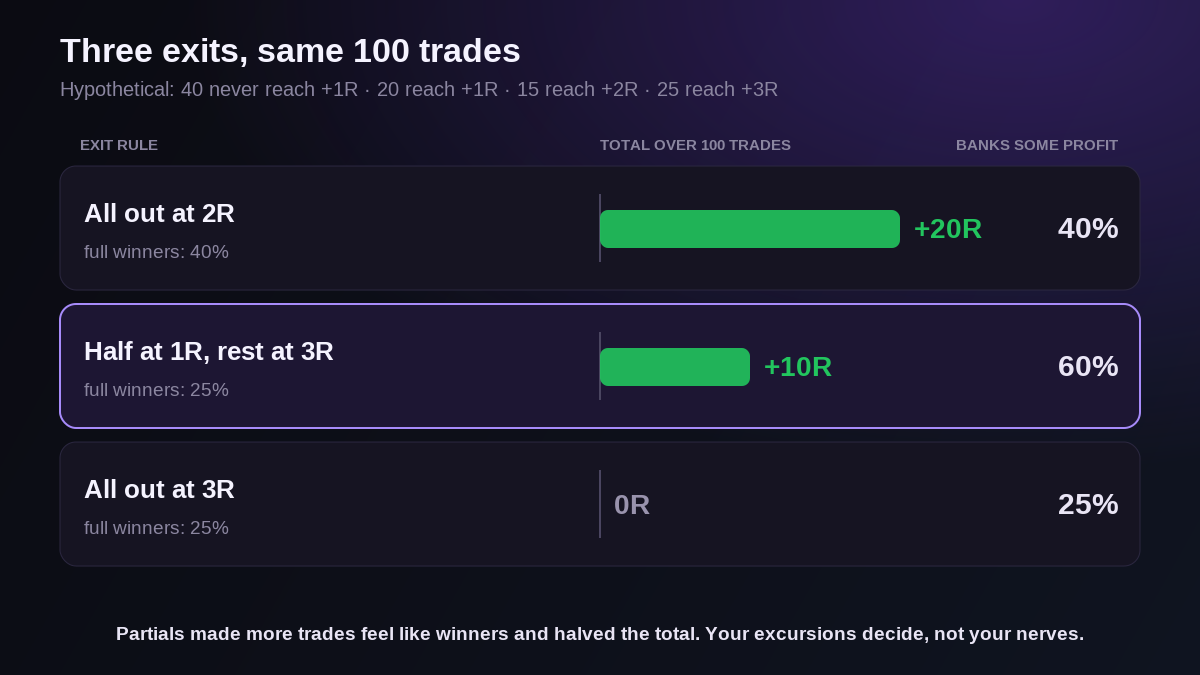
The partial rule is in the middle — better than holding everything for 3R, but half as good as simply taking 2R. And yet it feels like the best of the three, because 60% of trades bank something, against 40% and 25% for the others.
That gap between how it feels and what it pays is the whole issue with partials.
Why partials feel better than they are
- They raise the share of trades that bank some profit, which feels like a higher win rate. But the trades that hit +1R and come back now finish at zero instead of −1R or +2R — and that trade-off can go either way.
- They cap your best trades. On the trades that run all the way, half the position was closed at +1R. Strategies that make their money on a few large winners are the ones partials hurt most.
- They reduce variance. That part is real, and for some traders — especially on prop accounts with tight drawdown — smoother equity is worth a lower total. Just make that choice knowingly.
When partials help
Partials are not wrong, they are a bet on a particular shape of trade. They tend to pay when:
- Many trades reach +1R and then reverse before your full target. Banking half at +1R turns those from losers into scratches.
- Few trades run far. If your +3R target is rarely reached, holding a full position for it wastes the move most trades do make.
- You move the stop to breakeven after the partial — but only if your trades do not routinely dip back to entry before running. That is a separate question with its own data (see our post on MAE and MFE).
In the example, the 20 trades that reach +1R and come back are what partials are designed for — but there are not enough of them to pay for capping the 25 trades that go all the way.
Test it on your own trades
You do not need to guess. For each past trade you need one number: how far it went in your favour before it stopped out or you closed it (the maximum favourable excursion, in R). Sort your trades into the four buckets above, then re-run each exit rule as a spreadsheet exercise. Twenty minutes of arithmetic will tell you more than years of opinions on the subject.
If you do not have excursion data, collect it going forward, or practise both rules on the same days in replay and compare.
In Replay
Retrace's Replay supports exactly this rule: give a position a second target and it closes half at TP1, then lets the rest run to TP2. Trade a few sessions with a single target and a few with the split, on the same market and session, and compare the results in R. The sessions are scored the same way, so the comparison is fair.