Replay vs backtesting vs demo: which one actually makes you better?
Three ways to practise without risking money, and they answer different questions. Backtesting tests the idea, replay tests whether you can execute it, demo tests the routine — and most beginners skip the middle one.
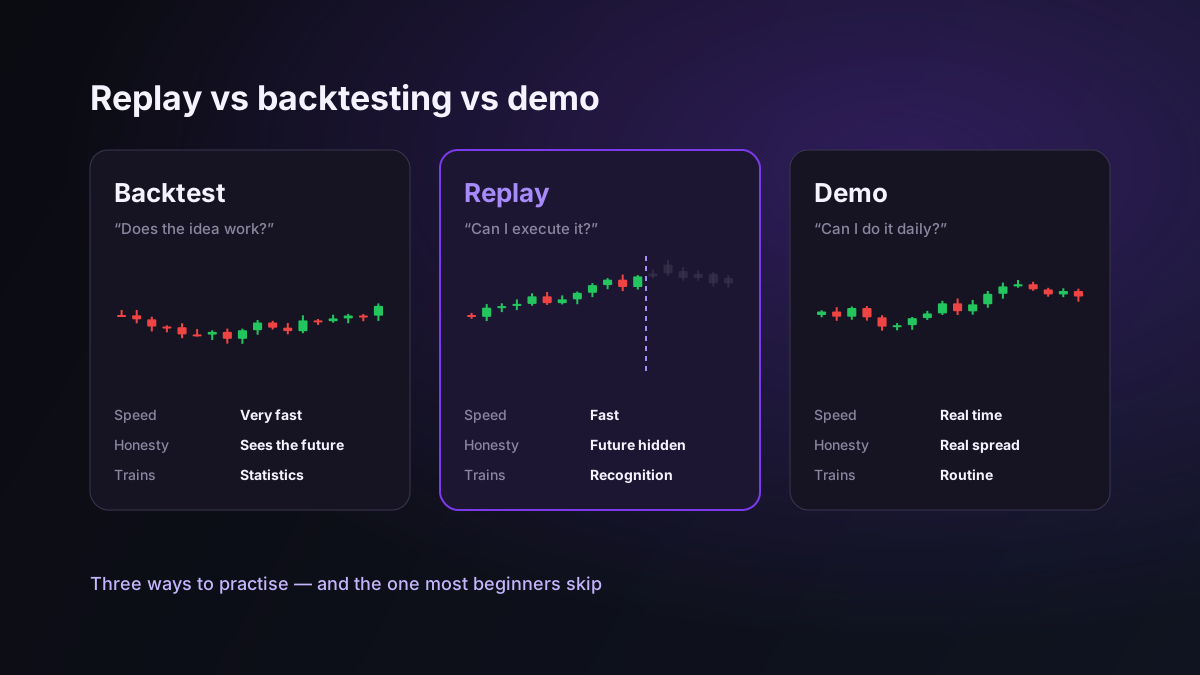
Three ways to practise trading without risking real money — and they're not the same thing, even though people use the words interchangeably. Pick the wrong one for the question you're asking and you'll spend a lot of hours getting confident about the wrong thing.
Backtesting: does the idea work at all?
Backtesting means scrolling back through history and marking, systematically, every time your rules would have fired — then adding up what happened. You're not "trading" anything. You're auditing an idea across hundreds of instances as fast as you can click.
What it's for: killing bad ideas quickly, and getting rough numbers — win rate, average R, how long the losing streaks are — before you spend real time on a strategy.
What it hides: you. Backtesting removes hesitation, fear, boredom and the fact that live candles don't come with the right edge of the chart already drawn. You also, unavoidably, see the outcome. That's fine for statistics and useless for practice.
Replay: can you execute it, in real time, without seeing the future?
Replay plays a past day forward, one candle at a time, with the future hidden. You trade it live — decisions, stops, targets, P&L — but on a day that already happened, at whatever speed you like, as many times as you want.
What it's for: turning knowledge into recognition. Practising the moment — the candle is forming, price is at your level, do you click or not? Doing that fifty times in a week instead of five.
What it hides: slippage, spread and the emotional weight of money that's really yours. Replay fills you at the exact stop and target. Real brokers don't. Treat replay results as slightly generous.
Demo trading: can you do it slowly, with real spread, in real time?
A demo account is a live account with fake money. Real spread, real slippage, real news, real clock — one London open per day, no fast-forward.
What it's for: platform mechanics, execution under real conditions, and building the daily routine you'll keep when the money is real.
What it hides: almost nothing about the market and almost everything about you, because it isn't your money. It's also slow — a month of demo gives you twenty sessions. A month of replay can give you a hundred.

The honest comparison
| Backtesting | Replay | Demo | |
|---|---|---|---|
| Speed of learning | Very fast | Fast | Slow (real time) |
| Future hidden | No | Yes | Yes |
| Real spread & slippage | No | No | Yes |
| Trains recognition | Weak | Strong | Medium |
| Trains emotions | No | Some | Some |
| Best question | "Does the idea work?" | "Can I execute it?" | "Can I do this daily?" |
The order that actually makes sense
- Backtest the idea for an afternoon. If it doesn't survive fifty examples, stop here — you've saved a month.
- Replay it for two weeks. Same market, same session, different days. This is where "I know the setup" becomes "I recognise the setup while it forms". It's also where you find out whether you can sit on your hands when the setup isn't there.
- Demo for a couple of weeks to get the platform and the routine right, with real spread.
- Go live small. Smaller than you think. Journal every trade — because now the emotional variable is switched on and it will surprise you.
Most beginners skip step 2. They backtest (or worse, just read), then demo, then go live, and wonder why the setup they "know" keeps not looking like the pictures. Replay is the missing step. It's the one that's fast and honest about the future.
Where Retrace fits
Replay lives in your Retrace sidebar. Pick a market, a day and a session open, press play, trade it, review it. Sessions are kept so you can see how the same market treated you across days. When you go live, your real trades sync in and chart on the same candles — so the thing you practised and the thing you did line up on one screen.
Free accounts include three replay sessions a day; Pro is unlimited. Backtesting and demo you already have. This is the piece in between.