A pre-market plan you can write in 15 minutes
Decisions made before the open are calmer than decisions made during it. A six-step, fifteen-minute template, a filled-in example, and how to grade the session against it afterwards.
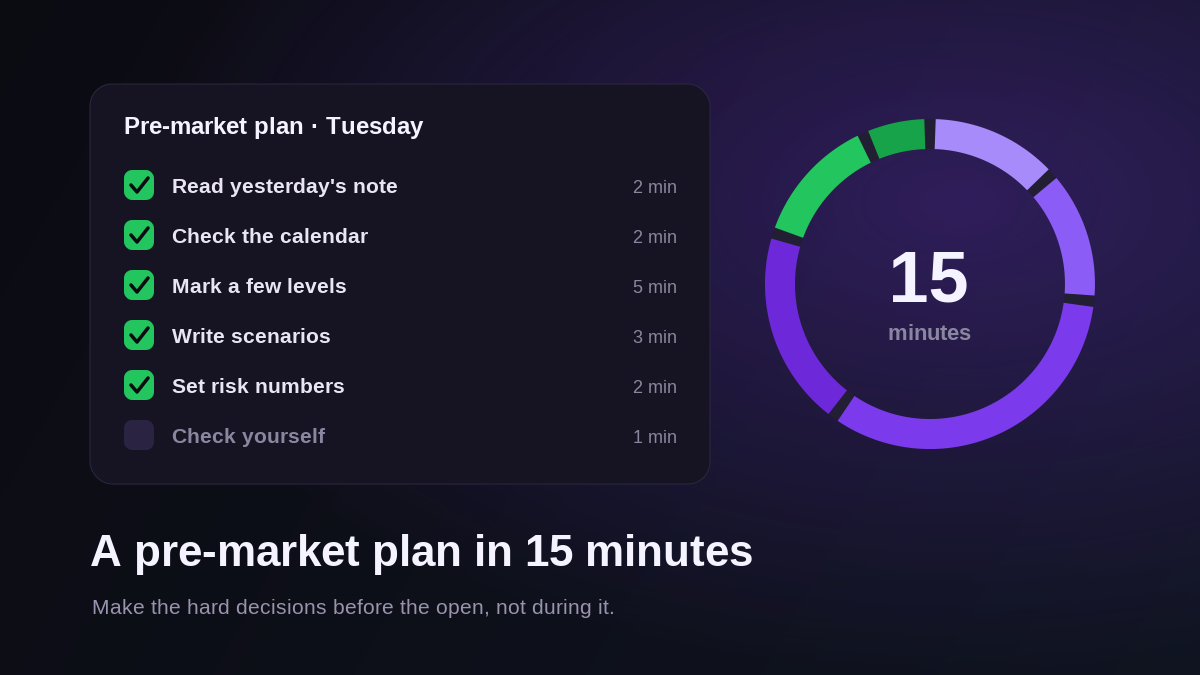
The worst decisions in trading are made in the moment: price is moving, you have a position on, and you are deciding something you could have decided an hour earlier with a coffee and no pressure. A pre-market plan is simply moving as many of those decisions as possible to the calm part of the day.
It does not need to be elaborate. A plan that takes an hour gets skipped by Thursday. The template below takes about fifteen minutes and covers everything that actually changes what you do once the session opens.
Why bother writing it down
Two reasons.
First, a written plan is a commitment. "I'll be careful around the data release" is a feeling. "No new entries from 13:20 to 13:45" is a rule you can either follow or break.
Second, it is the only honest yardstick for your review. If you decide after the session what you were "planning" to do, you will always find that you followed the plan. If it is written before the open, it cannot move.
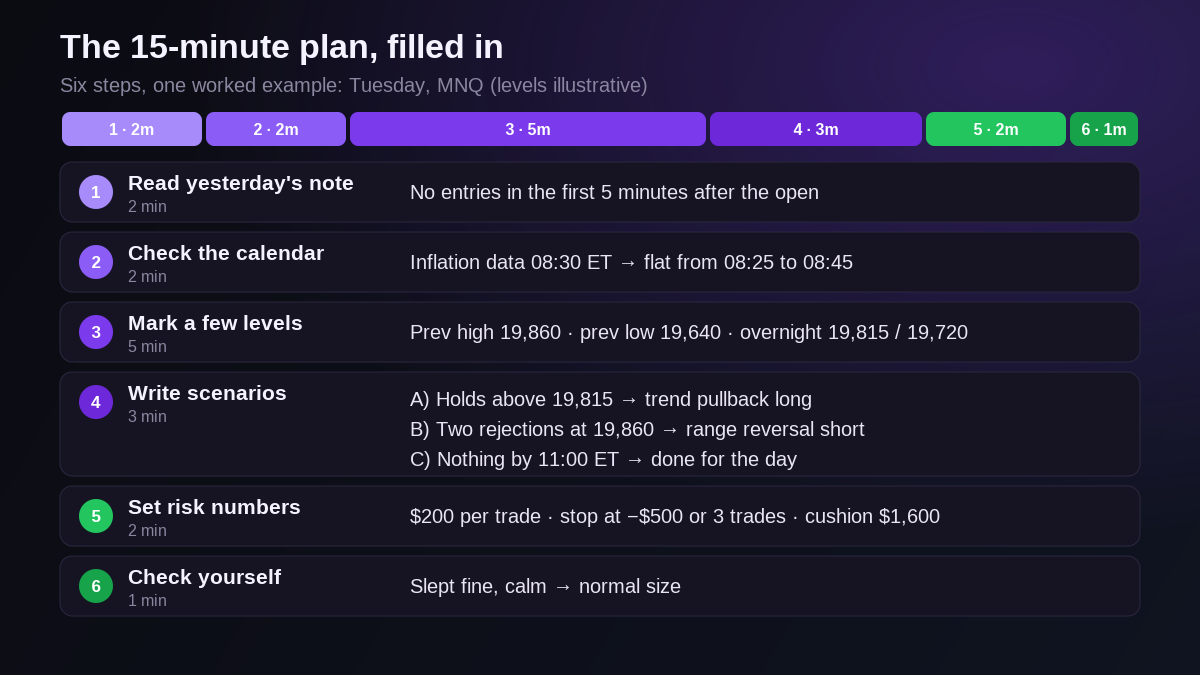
The 15-minute template
1. Read yesterday's note (2 minutes)
Start with the one thing you said you would change. If your last review ended with "stop entering in the first five minutes", that sentence goes at the top of today's plan. Most traders write good review notes and never read them again; this is the step that closes the loop.
2. Check the calendar (2 minutes)
Look for scheduled releases and events in the hours you will trade: central bank decisions, inflation and employment data, major speeches, and anything specific to your instrument (inventory data for oil, for example). For each one, decide now whether you will be flat through it, and write the window down.
3. Mark a few levels (5 minutes)
Use a higher timeframe and mark only the levels you would genuinely act on:
- Previous day's high, low and close.
- The overnight or Asian session range.
- One or two obvious higher-timeframe levels — a weekly high, a well-tested area.
Stop at five. A chart with fifteen lines on it does not have levels; it has decoration, and you will find a "reason" at any price.
4. Write two or three scenarios (3 minutes)
Not predictions — scenarios. Each one is an if/then, tied to a setup you already trade:
- If price breaks and holds above the overnight high after the open, then I look for a pullback entry — trend pullback setup.
- If price rejects the previous day's high twice, then I look for a fade back into the range — range reversal setup.
- If neither happens by 11:00, then I am done for the day.
The third kind of scenario is the most underrated. Deciding in advance what not trading looks like makes it much easier to do.
5. Set today's risk numbers (2 minutes)
- Risk per trade, in dollars.
- Maximum loss for the day, after which you stop.
- Maximum number of trades.
- If you are on a prop account: today's distance to the daily loss limit and to the drawdown floor.
6. Check yourself (1 minute)
How did you sleep? Are you carrying anything from yesterday — a big loss, a big win, something outside trading? Rate it honestly. On a bad day, the plan should get smaller: fewer trades, smaller size, or a shorter session.
A filled-in example
Here is what a finished plan might look like for an index futures trader. The levels are illustrative.
Tuesday — MNQ

From last review: no entries in the first 5 minutes after the open.

Calendar: inflation data 08:30 ET. Flat from 08:25 to 08:45.

Levels:
  Prev day high  19,860
  Prev day low   19,640
  Overnight high 19,815 / low 19,720

Scenarios:
  A) Acceptance above 19,815 after the open -> trend pullback long,
     stop below the pullback swing.
  B) Two rejections at 19,860 -> range reversal short toward 19,750.
  C) Nothing by 11:00 ET -> done.

Risk: $200 per trade. Stop for the day at -$500 or 3 trades.
Prop: daily limit $1,000, cushion to floor $1,600.

State: slept fine, calm. Normal size.
That is the entire thing. Anyone could read it and know what you are going to do.
What a plan is not
- It is not a forecast. You are not deciding where the market is going. You are deciding how you will respond to what it does.
- It is not a reason to force a trade. If none of your scenarios play out, the plan worked: it kept you out.
- It is not permanent. If something genuinely unexpected happens, you can stop and rewrite it. What you cannot do is quietly ignore it.
Grade the session against it
After the close, take two minutes and answer three questions:
- Did every trade I took belong to one of my scenarios?
- Did I respect the risk numbers and the news window?
- Did I stop when the plan said stop?
Score each yes or no. Over a few weeks, the correlation between "followed the plan" and "had a decent day" tends to become very obvious — and it is far more persuasive coming from your own data than from any article.
Where to keep it
Keep the plan next to the trades it produced. In Retrace, the daily journal sits alongside each day's trades and the calendar, so the plan you wrote at 08:00 is right there when you review the day, with your mood for each trade and the trades themselves already charted. The point is not the tool — a notebook works — but the plan has to be in the place you review, or you will stop comparing against it.
Fifteen minutes before the open buys you a session where most of the hard decisions are already made. That is about the cheapest edge there is.