Passing a prop firm challenge without gambling
Most challenges are not failed by bad analysis. They are failed by sizing up to hit a target before a deadline. Here is the arithmetic that makes passing boring.
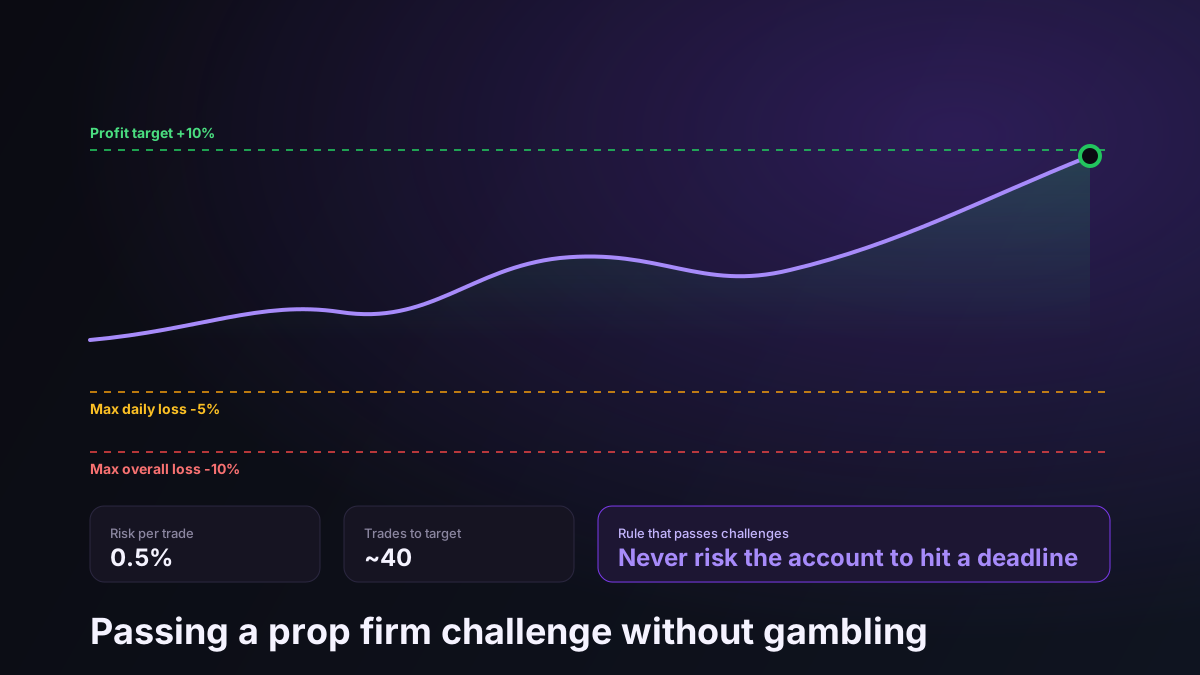
Prop firm challenges have a reputation for being nearly impossible. They are not. They are simply designed so that the behaviour most retail traders default to — sizing up to hit a number by a date — fails almost every time. Change that one behaviour and the challenge becomes a slow, boring, entirely survivable exercise.
The rules are a risk budget, not a target
A typical challenge gives you three numbers: a profit target of around 10%, a maximum daily loss of around 5%, and a maximum overall loss of around 10%. Traders read the first number and start planning how to reach it. That is backwards. The two loss limits are the real constraint, and everything about your plan should be derived from them.
Think of the maximum overall loss as your entire capital. If you can lose 10% before you are out, then 10% is your account for the purposes of sizing — not the notional balance on the platform. Suddenly "risk 1% per trade" means risking a tenth of everything you have on a single idea, which is a much less comfortable sentence and a much more honest one.
Size so the losing streak cannot end you
Risk 0.5% of the notional balance per trade and a five-loss streak costs you 2.5% — a quarter of your allowance, uncomfortable but survivable. Risk 2% per trade and the same streak costs 10% and the account is gone. The streak is not hypothetical. Any system with a win rate under 60% will string five losers together regularly; it is basic probability, not bad luck.
Now run the other direction. At 0.5% risk and an average winner of 2R, you need roughly forty net-positive trades to reach a 10% target. That sounds like a lot until you realise the alternative is needing five perfect trades in a row.
Ignore the deadline
The deadline is what turns disciplined traders into gamblers. With a week left and half the target to go, sizing up feels like the rational move. It is not — it is trading your survival for a calendar. Most firms now offer challenges with no time limit at all, and where a limit exists, failing it costs you the fee. Blowing the drawdown costs you the fee and teaches you a habit that will cost you again on the funded account.
If the clock runs out, you reset and start again with your process intact. That is a cheaper outcome than passing with a method you cannot repeat.
Journal the challenge like it is already funded
The point of the challenge is not the payout. It is proving that a repeatable process clears the bar. So journal it exactly as you would a funded account, from day one:
- Every trade tagged with the setup from your playbook, so you can see which one is actually carrying you.
- Risk logged in R before entry, so size drift shows up as data rather than a feeling.
- Distance to the daily loss limit checked before every entry, not after.
- A note on every rule break, especially the profitable ones.
When you pass, that journal is the thing you keep. The funded account is just the account. The evidence that your process clears a 10% target inside a 10% drawdown budget is what lets you trade it without flinching.
The unglamorous summary
Pass rates are low because the challenge rewards patience and most people arrive impatient. Size from the loss limit, ignore the deadline, take the same setups you would take with your own money, and let forty ordinary trades do the work of five heroic ones. Boring is the strategy.