Sizing futures: ticks, points, micros and minis
Futures sizing is the same risk formula as forex, with different units. Contract specs for the common index, gold and oil contracts, worked examples on MNQ, MES and MGC, and why tight stops quietly multiply your fees.
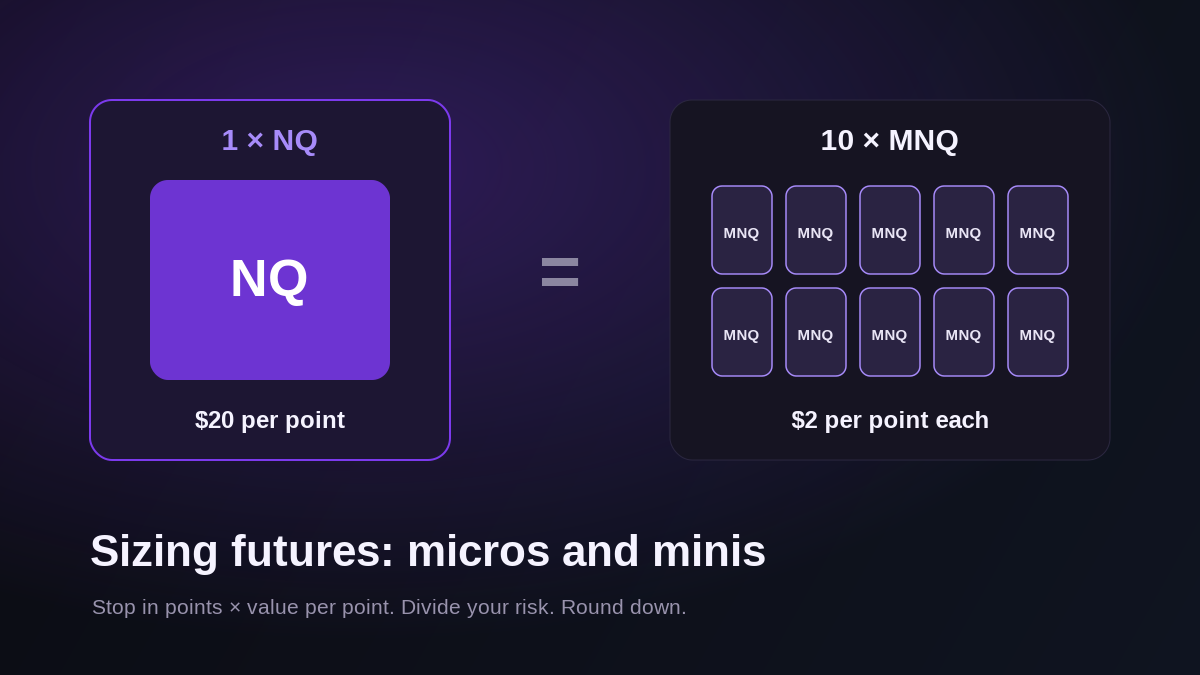
If you came to futures from forex or CFDs, sizing can feel strangely coarse. You cannot trade 0.37 of a contract. One E-mini Nasdaq moves $20 a point, and on a day when it moves 300 points that is a lot of money per contract. The good news is that the principle is exactly the same as any other market: the stop sets the size, never the other way round. Only the units change.
Ticks, points and what each one is worth
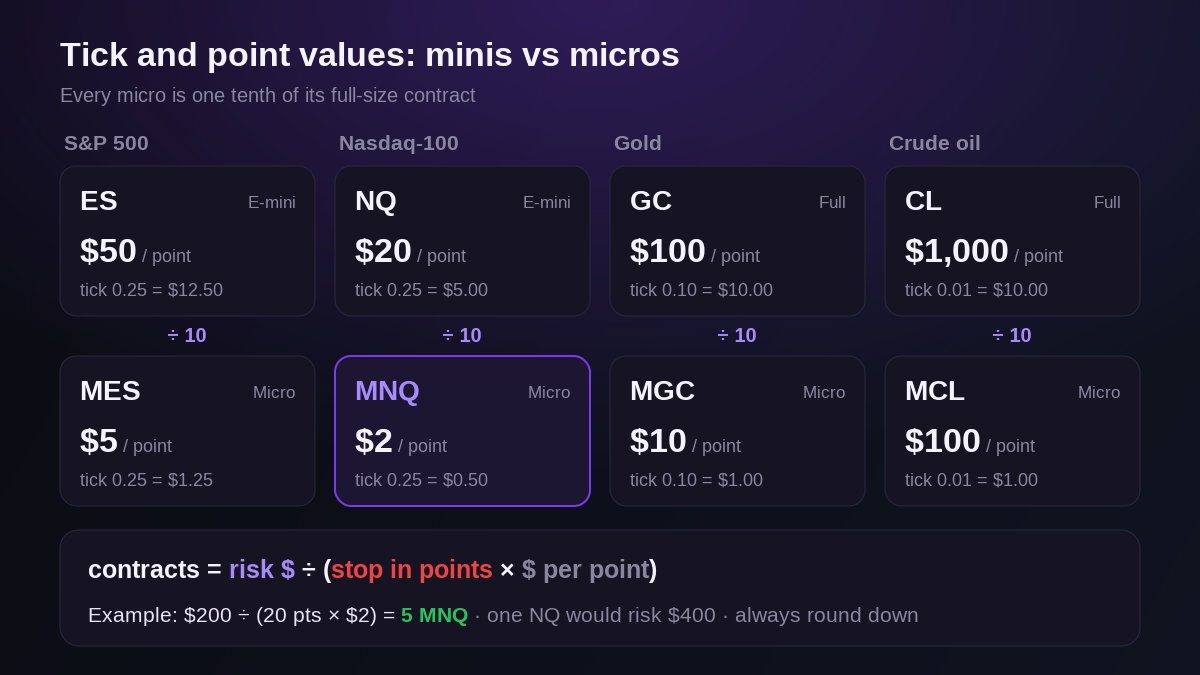
Every futures contract has a minimum price increment (a tick) and a fixed dollar value for that increment. Multiply up and you get the value of a full point, which is the number you actually size with.
| Contract | Tick size | Tick value | Value per 1.00 point |
|---|---|---|---|
| ES (E-mini S&P 500) | 0.25 | $12.50 | $50 |
| MES (Micro E-mini S&P 500) | 0.25 | $1.25 | $5 |
| NQ (E-mini Nasdaq-100) | 0.25 | $5.00 | $20 |
| MNQ (Micro E-mini Nasdaq-100) | 0.25 | $0.50 | $2 |
| GC (Gold) | 0.10 | $10.00 | $100 |
| MGC (Micro Gold) | 0.10 | $1.00 | $10 |
| CL (Crude Oil) | 0.01 | $10.00 | $1,000 |
| MCL (Micro Crude Oil) | 0.01 | $1.00 | $100 |
These come from the exchange's contract specifications; confirm them against your broker or platform, especially for any contract not listed here. The pattern to notice is that each micro is one tenth of its full-size contract. Ten MNQ carry the same exposure as one NQ.
The formula
contracts = risk in dollars ÷ (stop in points × value per point)
Always round down. Rounding up means risking more than you decided to.
Example 1: MNQ with a 20-point stop
You risk $200 per trade. Your setup puts the stop 20 points away.
- One NQ would risk 20 × $20 = $400. Too much — you cannot trade half a contract.
- One MNQ risks 20 × $2 = $40. So $200 ÷ $40 = 5 MNQ, risking exactly $200.
This is the whole case for micros: they give you the granularity to hit your risk number instead of being forced to double it or skip the trade.
Example 2: the same account, a 35-point stop
$200 ÷ (35 × $2) = $200 ÷ $70 = 2.86, which rounds down to 2 MNQ. Your actual risk is $140, not $200.
That matters for your statistics. If this trade loses, it lost $140, which is 0.7 of your usual risk unit — not a full 1R. Log risk as what you actually put on, so your R-multiples stay honest.
Example 3: MES with a 6-point stop
$200 ÷ (6 × $5) = $200 ÷ $30 = 6.67, rounding down to 6 MES, risking $180.
Example 4: Micro Gold with a $4.50 stop
Gold is quoted in dollars per ounce, so a $4.50 move is 4.50 points. $200 ÷ (4.50 × $10) = $200 ÷ $45 = 4.44, rounding down to 4 MGC, risking $180.
Tight stops multiply your fees
Here is the part that catches scalpers. Commissions and exchange fees are charged per contract, not per dollar risked. So the tighter your stop, the more contracts you need for the same risk — and the more you pay to take the trade.
Suppose, purely for illustration, that your all-in cost is about $1.00 per micro contract per round turn (check your own fee schedule; it varies by broker, firm and contract).
| Stop on MNQ | Contracts for $200 risk | Round-turn cost | Cost as a share of 1R |
|---|---|---|---|
| 40 points | 2 | $2 | 0.01R |
| 20 points | 5 | $5 | 0.025R |
| 8 points | 12 | $12 | 0.06R |
| 4 points | 25 | $25 | 0.125R |
At a 4-point stop, every trade starts 0.125R in the hole before price moves at all. If your edge is a few tenths of an R per trade, fees can consume a large slice of it. Nothing about this shows up if you only look at the chart — it only shows up when your journal records net P&L with fees included.
Micros or minis?
Once your size reaches ten micros, you can usually express the same exposure as one mini. Whether that is cheaper depends on your fee schedule: per-contract costs on micros are generally lower than on minis, but not one tenth as much, so compare the cost of ten micros against one mini for your own account. What micros always give you is finer control — nine MNQ is a valid position; 0.9 NQ is not.
Prop firm contract limits
Most futures evaluations cap the number of contracts you can hold, and some scale that cap up as the account grows. The cap is a ceiling, not a target. Size from your risk per trade first and only then check you are under the limit. If the formula says 12 MNQ and the account allows 15, you trade 12.
Contract months and your stats
Futures symbols carry an expiry: September Micro Nasdaq is MNQU6, December is MNQZ6. If your journal treats those as different instruments, your MNQ history fragments every quarter. Retrace stores the root symbol, so every MNQ trade lands in one bucket across rolls, and it records net P&L with fees separated out so the cost of your contract count is visible.
The habit
Before every entry: stop in points, value per point, risk in dollars, divide, round down. Then write down what you actually risked. It is ten seconds of arithmetic, and it is the difference between a track record you can read and one where every trade was a different size for a different reason.