How to build a trading playbook from your own trades
A playbook is a short list of named setups with written rules — built from what already works for you, not from what you saw online. How to find your setups in your history, write them down, and measure each one.
Most traders say they have a strategy. Ask them to write it down and you get a paragraph that could describe almost any trade: "I trade with the trend, look for good levels, and wait for confirmation." That is not a strategy. It is a mood.
A playbook fixes this. It is a short list of named setups, each with written rules precise enough that you could hand them to someone else and they would take roughly the same trades. Done well, it is the single most useful document a discretionary trader can own, because it is the thing that lets your statistics mean something.
What goes in a playbook
For each setup, write:
- A name. Short and specific — "London range breakout", not "breakout".
- One sentence on when it applies. The market condition it is built for.
- Required rules. Things that must all be true before you enter. If one is missing, it is not this setup.
- Optional confluences. Things that make it better but are not mandatory.
- Stop placement. Where the trade is wrong, defined by structure.
- Target and management. Where you take profit, and whether you scale out or move your stop.
- When not to take it. The conditions that kill the setup: news, time of day, a nearby opposing level.
- Examples. A few screenshots of textbook versions of the trade.
Build it from your history, not from inspiration
The temptation is to start a playbook by writing down setups you have read about. Resist it. Start from the trades you have already taken, because they contain the setups you actually execute.
- Pull your last fifty to a hundred closed trades.
- Open the winners — especially the clean ones you would happily take again — and look at the chart for each.
- Group them by what they had in common: the same kind of level, the same trigger, the same time of day.
Most traders find two or three recurring patterns that account for most of their good trades. Those are your first setups. Everything that does not fit a pattern goes into a bucket you label honestly: no setup.
A written example
Here is what a single setup might look like once written out:
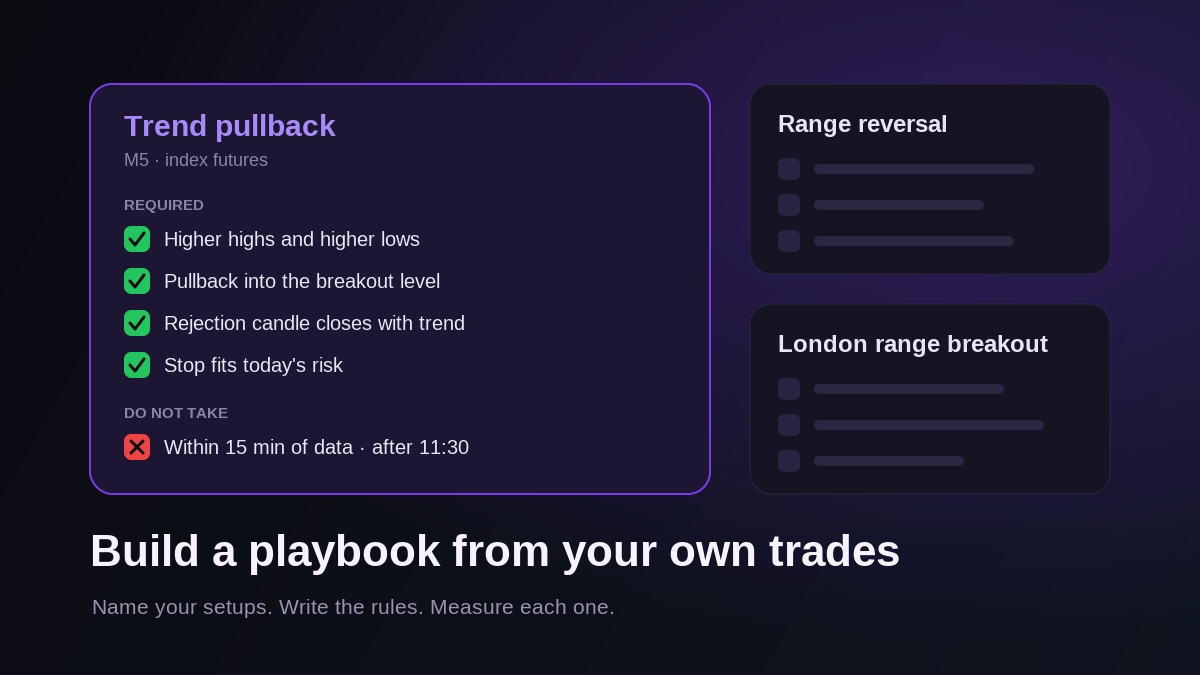
Trend pullback (M5, index futures)
When: a clear intraday trend after the session open.
Required: higher highs and higher lows on M5 (or the reverse for shorts) · pullback into the prior breakout level or a rising moving average · a rejection candle that closes back in the trend direction · stop fits inside today's risk per trade.
Optional: higher-timeframe trend agrees · pullback on declining volume.
Stop: beyond the pullback swing low (or high).
Target: the prior swing high, then trail the rest behind M5 structure.
Do not take: within 15 minutes of scheduled data · after 11:30 · directly into a higher-timeframe level.
Notice how much of it is about when not to trade. That section usually carries more of the edge than the entry rules do.
Tag every trade, including the ones that do not fit
Once the playbook exists, every trade gets tagged with the setup it was — or with no setup if it was not one of them. Be strict. A trade that met four of five required rules is not that setup; it is a trade where you talked yourself past a rule.
The no setup bucket is uncomfortable to look at, and that is exactly why it is valuable.
Measure each setup separately
After a month or two, compare setups side by side. Use R-multiples so position size does not distort the picture. A hypothetical example:
| Setup | Trades | Win rate | Avg win | Avg loss | Expectancy |
|---|---|---|---|---|---|
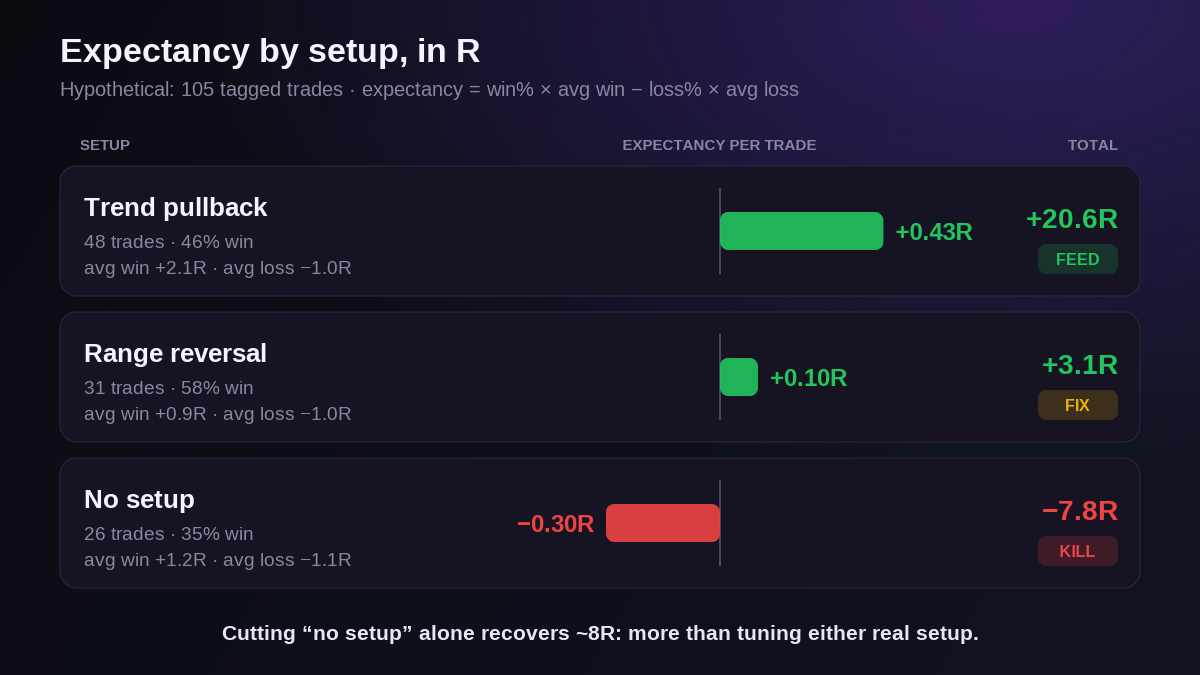
| Trend pullback | 48 | 46% | +2.1R | −1.0R | +0.43R |
| Range reversal | 31 | 58% | +0.9R | −1.0R | +0.10R |
| No setup | 26 | 35% | +1.2R | −1.1R | −0.30R |
Expectancy here is simply (win rate × average win) − (loss rate × average loss). For the trend pullback: 0.46 × 2.1 − 0.54 × 1.0 = +0.43R per trade.
Three very different stories:
- Trend pullback is the engine. Lower win rate, but the winners are big. This is the setup to protect and, if anything, to take more carefully.
- Range reversal wins more often but barely pays. A small edge like this is easy to erase with fees or one sloppy trade. It needs a closer look — maybe a better target, maybe a stricter filter.
- No setup loses 0.30R every time. Twenty-six trades × −0.30R is about −8R thrown away. Cutting this bucket alone is worth more than tuning either real setup.
Kill, fix or feed
Review each setup every month or so and make one of three decisions:
- Feed the setups with a clear positive expectancy on a reasonable sample. Make sure you are not skipping valid ones.
- Fix the marginal ones by changing one rule and measuring again. Change three at once and you will not know which one mattered.
- Kill the ones that are negative after a fair sample. It is hard to delete a setup you like. It is harder to keep paying for it.
When you change a rule, note the date. Results before and after a rule change are not the same setup, and mixing them hides whether the change worked.
Keep it short
A playbook with twelve setups is a playbook you do not know by heart. Two to four is plenty for most people. The aim is that, mid-session, you can glance at a chart and know within seconds whether it is one of yours — and if it is not, that you do nothing.
In Retrace
The Playbook page holds your setups with their rules, each marked as required or optional, and there are starter templates — breakout, trend pullback, range reversal and more — that you can add and then rewrite in your own terms. Tag each trade with its strategy and the dashboard can filter every statistic by setup, so the table above is something you look up rather than build in a spreadsheet.
Whatever you use, the principle is the same: write down what you do, measure each piece separately, and let the numbers decide what stays.