A daily loss limit you'll actually respect
Most traders have a daily loss limit. Far fewer stop when they hit it. How to pick the number, why it should be in R, the second rule that catches the days a plain limit misses, and how to make stopping automatic.
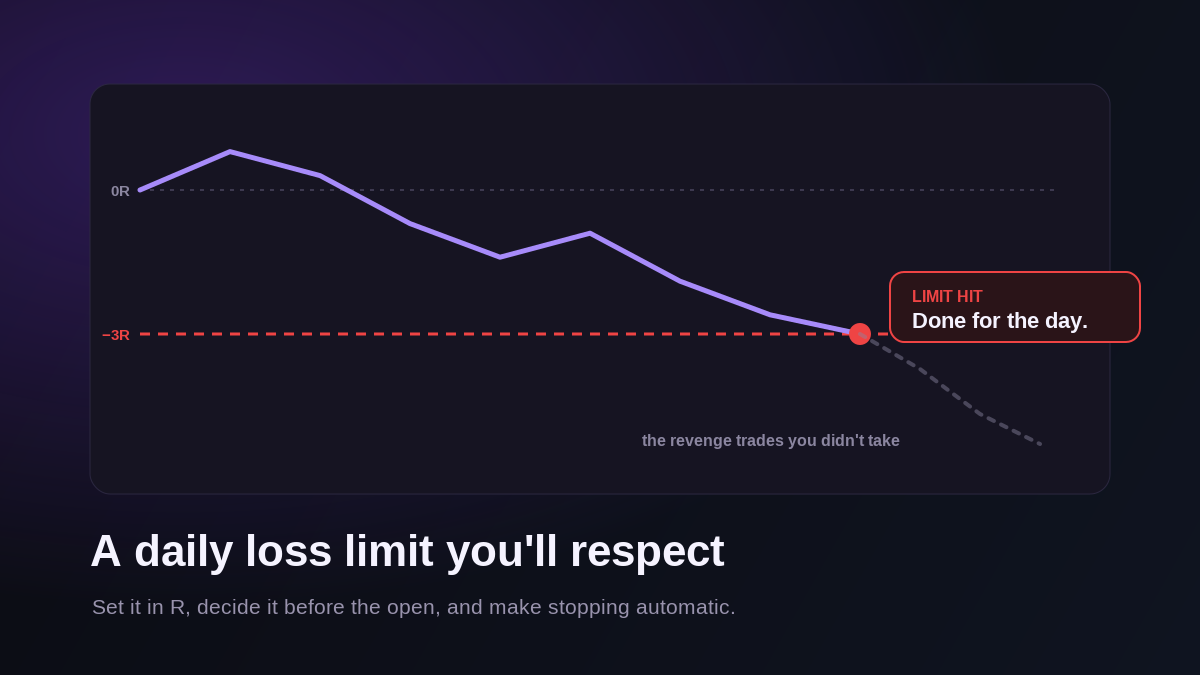
Ask a room of traders whether they have a daily loss limit and nearly every hand goes up. Ask how many stopped the last time they reached it and most of the hands come down.
A limit you only respect on calm days is not a limit. It is a number you feel bad about afterwards. This post is about choosing a limit you will actually keep, and setting things up so keeping it does not depend on how you feel at 11:40 after three losers.
Why the limit exists
A daily limit is not there to protect you from the market. It is there to protect you from yourself, on the specific days when you are least able to do it.
The losses that break accounts are rarely one bad trade. They are a sequence: a normal loss, then another, then a trade taken to get it back, sized up because it has to work, then another. The first three losses are the cost of doing business. Everything after that is the cost of not stopping.
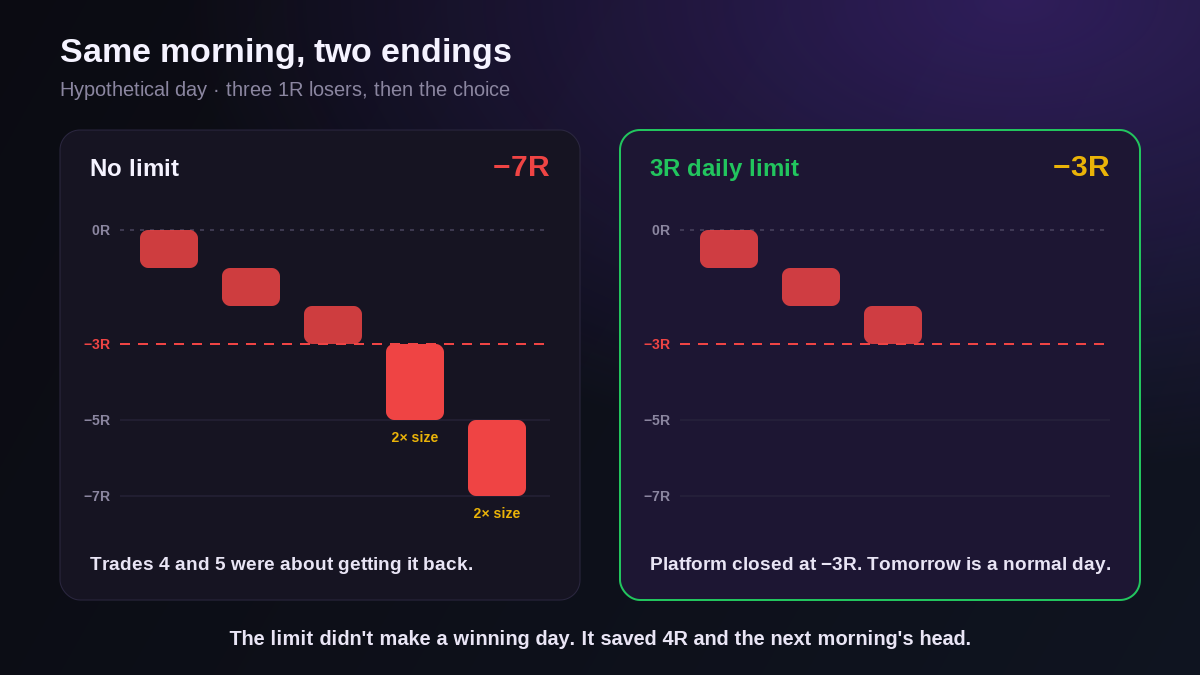
In the example, both days start the same way: three ordinary 1R losses. Without a limit, the next two trades are taken at double size to win it back, and the day ends at −7R. With a 3R limit, the day ends at −3R. The limit did not create a winning day — nothing would have — but it saved 4R, and the next morning starts as a normal day instead of a hole.
Pick the number in R
Set the limit in R, not dollars, so it stays meaningful when your size changes. Common choices:
- 2R to 3R for most discretionary day traders.
- A number of losses — "three losers and I'm done" — which is the same idea and easier to count mid-session.
To sanity-check it, look at your own history. How often do your days finish worse than −3R, and what do those days have in common? For many traders the answer is that nearly all of their worst days went through −3R first and then got much worse. That is exactly the stretch the limit removes.
If you trade a prop account, the firm's daily loss rule is the ceiling, not your limit. Set your own well inside it, so a bad day costs you a day and not the account.
Add a giveback rule
A plain loss limit misses one kind of bad day: the one where you are up +3R by 10:00 and finish at breakeven after an afternoon of forcing it.
So add a second rule: stop if you give back half of the day's peak. Up +3R, back to +1.5R, done. It feels painful to stop while still green. It is less painful than the alternative, which is usually red.
Make stopping automatic
The point of deciding in advance is that you are not the one deciding at the time. Some ways to take the decision away from yourself:
- Write the limit in the pre-market plan, in numbers, before the open. A limit you invent mid-session is a limit you will renegotiate.
- Use the platform. Many brokers and prop platforms can enforce a daily loss lock. If yours can, turn it on; it is the only version of the rule that cannot be argued with.
- Close the platform, not just the chart. When the limit hits, close the trading platform and leave the desk. If the platform stays open, the next "small" trade is one click away.
- Have a next action ready. "Stop trading" is a vacuum. "Stop trading and log the three trades, then go for a walk" is a plan.
Review the days you hit it
Every day that hits the limit deserves five minutes the next morning. Not to relive it — to answer two questions:
- Were the losing trades valid setups, taken correctly? If yes, it was a normal losing day and the limit did its job.
- Were they not? Then the limit caught a process problem — chasing, overtrading, ignoring your plan — and that is what to work on, not the limit.
Over a few months, the second list becomes one of the most useful things in your journal.
In Retrace
The daily journal's plan has a max loss and a max number of trades for the day. Retrace checks both against the day's actual trades as they come in and flags the day when you go past either one, so the limit you wrote at 08:00 is right there next to the trades that broke it.